Showing posts with label performance. Show all posts

Wednesday, February 27, 2013

Issue No. 235: Pleading in the Blood


tagzeen:
Pleading in the Blood: The Art and Performances of Ron Athey
T|A|G is excited to announce the publication this summer of the first book devoted to the seminal and influential performance artist Ron Athey.

Edited by Dominic Johnson, Pleading in the Blood includes three newly commissioned essays on different aspects of Athey’s work by Adrian Heathfield, Amelia Jones, and Dominic Johnson. These scholarly essays are complemented by shorter texts by Homi K. Bhabha, Jennifer Doyle, Tim Etchells, Guillermo Gómez-Peña, Matthew Goulish, Lydia Lunch, Juliana Snapper, Julie Tolentino, Alex Binnie, Catherin (Saalfield) Gund, Bruce LaBruce and Catherine Opie. The book will also include Athey’s own writings, including new pieces and hard-to-find archival texts
Pleading in the Blood is lavishly illustrated with full-colour images by photographers including Catherine Opie, Manuel Vason, Elyse Regher, Slava Mogutin, Dona Ann McAdams, Bruce LaBruce, Rick Castro, Sheree Rose, Edward Colver, Jennifer Precious Finch, and others.
Antony Hegarty (Antony and the Johnsons) has written a foreword to the publication.
Launch events will be announced soon.
Front cover image courtesy of Regis Hertrich, from Athey’s Solar Anus at The Hayward Gallery, London. Curated by Lee Adams for the Undercover Surrealism exhibition (2006).
Intellect Live is a new collaboration between Intellect Books and the Live Art Development Agency dedicated to influential artists working at the edges of performance.
http://ronatheynews.blogspot.co.uk/
http://www.thisisliveart.co.uk/index.html
http://www.intellectbooks.co.uk/
(Reblogged from tagzeen)

Wednesday, February 13, 2013

Issue No. 234: Lee Adams will guest-curate TAG E-Zine

Lee Adams as Minotaur
Lee Adams is a London based artist / curator / promoter and DJ.

For the past 25 years Lee Adams has been living and working in the fecund, esoterotic cracks between performance art and night culture, philosophy and dissidence. From strip clubs, tunnels, pissoirs, power stations and slaughterhouses to palaces, churches, galleries, opera houses, theatres and ruins, from New York to Naples and Berlin to the Mohave Desert he has staged elaborate acts of defiance, excess and abandon. He has collaborated with a wide range of maverick artists including Ron Athey, Vaginal Davies, Bruce LaBruce, Kira O'Rielly, Peter Christopherson, Franko B, Manuel Vason, Gio Black Peter, Julie Tolentino, Slava Mogutin and Brian Kenny, Othon Mataragas, Ernesto Tomasini and Hector De Gregorio.

Lee will guest curate for TAG (tagzeen.com) from Monday 2/18 - 2/24.

Photo: Predrag Pajdic

Thursday, October 4, 2012

Issue No. 226: AA Bronson Lecture on October 10, 2012

AA Bronson and Nicolaus Chaffin, Ashes to Ashes, 2012, performance view.


The MFA in Visual Studies presents AA Bronson

Applications for the MFA in Visual Studies are now being accepted for
Fall 2013 and are due February 1, 2013. To learn more, go to pnca.edu/graduate/vs.

AA Bronson Lecture: October 10, 6:30pm

Swigert Commons
1241 NW Johnson Ave
Free and open to the public

www.pnca.edu

AA Bronson visits Pacific Northwest College of Art (PNCA) to kick off the MFA in Visual Studies 2012–13 Graduate Visiting Lecture Series. Bronson is the first of a series of renowned artists who come to campus to engage with students and the community through lectures, conversations, group critiques, workshops, and studio visits. These visiting artists contribute to, challenge, and expand the academic and artistic discourse of the MFA in Visual Studies program.

Bronson's visit builds on previous connections with the MFA in Visual Studies program. With Chair Arnold J. Kemp, students visited with Bronson at Printed Matter in NYC in 2009. In 2011, PNCA's Feldman Gallery + Project Space hosted the exhibition curated by Bronson, Learn to Read Art: A History of Printed Matter.

Read more about AA Bronson and his views on creative practice on UNTITLED, PNCA's online magazine.


About the MFA in Visual Studies
PNCA's MFA in Visual Studies is a multidisciplinary, mentor-based program that encourages independent inquiry and supports critical approaches to the production of visual art. The flexible structure and generalist nature of the program allow students to pursue a single discipline, such as painting, or a combined practice that bridges multiple disciplines and media, including but not limited to: animation, communication design, illustration, installation, painting, photography, printmaking, sequential arts, sculpture, sound, performance, and video. As a complement to intensive one-on-one faculty mentorships, students benefit from contact with a rich network of instructors, critical thinkers, writers, and curators in the Portland area, as well as exposure to a dynamic roster of acclaimed visiting artists and designers. Seminars, lectures, exhibition opportunities, and national and international travel, add to a rigorous and investigative educational experience where experienced makers refine and expand their creative practices.

MFA+MA Programs
Portland, Oregon
PNCA offers five master's programs that prepare students for a life of creative practice: the Master of Fine Arts in Applied Craft and Design (offered jointly with Oregon College of Art and Craft), the Master of Fine Arts in Collaborative Design, the Master of Arts in Critical Theory and Creative Research, the Master of Fine Arts in Visual Studies, and the Low-Residency Master of Fine Arts in Visual Studies.

About AA Bronson
AA Bronson formed General Idea with Felix Partz and Jorge Zontal in 1969. The trio lived and worked together for 25 years, undertaking more than 100 exhibitions and public art projects. They were known for their magazine, FILE (1972–1989), their production of low-cost multiples, and their early involvement in punk, queer theory, and AIDS activism. In 1974, General Idea founded Art Metropole, a distribution center and archive in Toronto for artists' books, audio, video, and multiples. Bronson's solo work focuses on death, grieving, and healing. He founded the Institute for Art, Religion, and Social Justice at Union Theological Seminary in New York City.

- Arts & Education

Sunday, August 12, 2012

Issue No. 217: Pussy Riot


Nadezhda Tolokonnikova
Closing Statement
8 August 2012, Khamovnichesky Courthouse, Moscow

Essentially, it is not three singers from Pussy Riot who are on trial here. If that were the case, what’s happening would be totally insignificant. It is the entire state system of the Russian Federation which is on trial and which, unfortunately for itself, thoroughly enjoys quoting its cruelty towards human beings, its indifference to their honour and dignity, the very worst that has happened in Russian history to date. To my deepest regret, this mock trial is close to the standards of the Stalinist troikas. Thus, we have our investigator, lawyer and judge. And then, what’s more, what all three of them do and say and decide is determined by a political demand for repression. Who is to blame for the performance at the Cathedral of Christ the Saviour and for our being put on trial after the concert? The authoritarian political system is to blame. What Pussy Riot does is oppositional art or politics that draws upon the forms art has established. In any event, it is a form of civil action in circumstances where basic human rights, civil and political freedoms are suppressed by the corporate state system.
Many people, relentlessly and methodically flayed alive by the destruction of liberties since the turn of the century, have rebelled.
We were looking for authentic genuineness and simplicity and we found them in our punk performances. Passion, openness and naivety are superior to hypocrisy, cunning and a contrived decency that conceals crimes. The state’s leaders stand with saintly expressions in church, but their sins are far greater than ours. We’ve put on our political punk concerts because the Russian state system is dominated by rigidity, closedness and caste. Аnd the policies pursued serve only narrow corporate interests to the extent that even the air of Russia makes us ill.
We are absolutely not happy with—and have been forced into living politically—by the use of coercive, strong-arm measures to handle social processes, a situation in which the most important political institutions are the disciplinary structures of the state - the security agencies, the army, the police, the special forces and the accompanying means of ensuring political stability: prisons, preventive detention and mechanisms to closely control public behaviour. Nor are we happy with the enforced civic passivity of the bulk of the population or the complete domination of executive structures over the legislature and judiciary. Moreover, we are genuinely angered by the fear-based and scandalously low standard of political culture, which is constantly and knowingly maintained by the state system and its accomplices. Look at what Patriarch Kirill has to say: “The Orthodox don’t go to rallies.” We are angered by the appalling weakness of horizontal relationships within society. We don’t like the way in which the state system easily manipulates public opinion through its tight control of the overwhelming majority of media outlets. A perfect example is the unprecedentedly shameless campaign against Pussy Riot, based on distorting facts and words, which has appeared in nearly all the Russian media, apart from the few independent media there are in this political system.
Even so, I can now state—despite the fact that we currently have an authoritarian political situation—that I am seeing this political system collapse to a certain extent when it comes to the three members of Pussy Riot, because what the system was counting on, unfortunately for that system, has not come to pass. Russia as a whole does not condemn us. Every day more and more people believe us and believe in us, and think we should be free rather than behind bars. I can see this from the people I meet. I meet people who represent the system, who work for the relevant agencies. I see people who are in prison. And every day there are more and more people who support us, who hope for our success and especially for our release, who say our political act was justified. People tell us, “To start with, we weren’t sure you could have done this,” but every day there are more and more people who say, “Time is proving to us that your political gesture was correct. You have exposed the cancer in this political system and dealt a blow to a nest of vipers, which then turned on you.” These people are trying to make life easier for us in whatever way they can and we are very grateful to them for that…
We are grateful to all those who, free themselves, speak out in our support. There are a vast number, I know. I know that a huge number of Orthodox people are standing up for us. They are praying for us outside the courtroom, for the members of Pussy Riot who are incarcerated. We’ve seen the little booklets Orthodox people are handing out with prayers for those in prison. This shows that there isn’t a unified social group of Orthodox believers as the prosecution is endeavouring to say. No such thing exists. More and more believers are starting to defend Pussy Riot. They don’t think what we did deserves even five months in detention, much less the three years in prison the prosecutor would like. And every day, more and more people realize that if this political system has ganged up to this extent against three girls for a 30-second performance in the Cathedral of Christ the Saviour, it means the system is afraid of the truth and afraid of our sincerity and directness. We haven’t dissembled, not for a second, not for a minute during this trial, but the other side is dissembling too much and people can sense it. People can sense the truth. Truth really does have some kind of ontological, existential superiority over lies and this is written in the Bible, in the Old Testament in particular. In the end, the ways of truth always triumph over the ways of wickedness, guile and lies. And with each day that passes, the ways of truth are more and more triumphant even though we are still behind bars and are likely to be here a lot longer yet.
Madonna performed yesterday (7 August). She appeared with Pussy Riot written on her back. More and more people can see that we are being held here unlawfully and on a completely false charge – I’m overwhelmed by this. I am overwhelmed that truth really does triumph over lies even though physically we are here in a cage. We are freer than the people sitting opposite us for the prosecution because we can say everything we like, and we do, but those people sitting there say only what political censorship allows them to say. They can’t speak words like “punk prayer” or “Virgin Mary, Banish Putin!” They can’t say the lines from our punk prayer that have to do with the political system. Perhaps they think it wouldn’t be a bad thing to send us to jail because we are rising up against Putin and his system as well but they can’t say so because that’s not allowed either. Their mouths are sewn shut. Unfortunately, they are mere puppets. I hope they realize this and also take the road to freedom, truth and sincerity because these are superior to stasis, contrived decency and hypocrisy. Stasis and the search for truth are always in opposition to one another and, in this case, at this trial, we can see people who are trying to find the truth and people who are trying to enslave those who want to find the truth.
Humans are beings who always make mistakes. They are not perfect. They strive for wisdom but never actually have it. That’s precisely why philosophy came into being, precisely because philosophers are people who love wisdom and strive for it, but never actually possesses it and it is what makes them act and think and, ultimately, to live the way they do. This is what made us go into the Cathedral of Christ the Saviour, and I think that Christianity, as I’ve understood it from studying the Old and New Testaments, supports the search for truth and a constant overcoming of the self, overcoming what you used to be. Christ didn’t associate with prostitutes for nothing. He said, ‘I help those who have gone astray and forgive them’ but for some reason I can’t see any of that at our trial, which is taking place under the banner of Christianity. I think the prosecutor is defying Christianity. The lawyer wants nothing to do with the injured parties. Here’s how I understand this: Two days ago, Lawyer Taratukhin made a speech in which he wanted everyone to understand that he had no sympathy with the people he is representing. This means he’s not ethically comfortable representing people who want to send the three members of Pussy Riot to jail. Why they want to do this, I don’t know. Perhaps it is their right. The lawyer was embarrassed, the shouts of “Shame! Executioners!” had got to him, which goes to show that truth and goodness always triumph over lies and evil.
I think some higher powers are guiding the speeches of the lawyers for the other side when, time after time, they make mistakes in what they say and call us the “injured parties”. Almost all the lawyers are doing it, including Lawyer Pavlova who is very negatively disposed towards us. Nevertheless, some higher powers are causing her to say “the injured parties” about us rather than the people she’s defending, us. I wouldn’t give people labels. I don’t think there are winners or losers here, injured parties or accused. We just need to make contact, to establish a dialogue and a joint search for truth, to seek wisdom together, to be philosophers together, rather than stigmatizing and labelling people. This is one of the worst things people can do and Christ condemned it.
We have been subjected to abuse during this trial. Who would have thought that a person and the state system he controls would be repeatedly capable of entirely wanton evil? Who would have thought that history and Stalin’s Great Terror, in particular, not so very long ago, would not be taught at all? It makes you want to weep to see how the methods of the medieval inquisition are brought out by the law-enforcement and judicial system of the Russian Federation, which is our country. Since the time of our arrest, however, we can no longer weep. We’ve forgotten how to cry. At our punk concerts we used to shout as best we could about the iniquities of the authorities and now we’ve been robbed of our voice.
This whole trial refuses to hear us and I mean hear us, which involves understanding and, moreover, thinking. I think every individual wants to attain wisdom, to be a philosopher, not just people who happen to have studied philosophy. That’s nothing. Formal education is nothing in itself and Lawyer Pavlova is constantly accusing us of not being sufficiently well-educated. I think though that the most important thing is the desire to know and to understand, and that’s something people can do for themselves outside of educational establishments, and the trappings of academic degrees don’t mean anything in this instance. Someone can have a vast fund of knowledge and for all that not be human. Pythagoras said that ‘the learning of many things does not teach understanding’. Unfortunately, that’s something we are forced to observe here. It’s just a stage setting and bits of the natural world, bodies brought into the courtroom. If, after many days of asking, talking and doing battle our petitions are examined, they are inevitably rejected.
The court, on the other hand—and unfortunately for us and for our country—listens to the prosecutor who repeatedly distorts our comments and statements with impunity in a bid to neutralize them. There is no attempt to conceal this breach in an adversarial system. It even appears to be for show. On 30th July, the first day of the trial, we presented our response to the accusations. Prior to that we were in prison, in confinement. We can’t do anything there. We can’t make statements. We can’t make films. We don’t have the internet in there. We can’t even give our lawyer a bit of paper because that’s banned too. Our first chance to speak came on 30th July. The document we’d written was read out by defence lawyer Volkov because the court refused outright to let the defendants speak. We called for contact and dialogue rather than conflict and opposition. We reached out a hand to those who, for some reason, assume we are their enemies. In response they laughed at us and spat in our outstretched hands. “You’re disingenuous,” they told us. But they needn’t have bothered. Don’t judge others by your own standards. We were always sincere in what we said, saying exactly what we thought, out of childish naïvety, sure, but we don’t regret anything we said, even on that day. We are reviled but we do not intend to speak evil in return. We are in desperate straits but do not despair. We are persecuted but not forsaken. It’s easy to humiliate and crush people who are open, but when I am weak, then I am strong.
Listen to us rather than to Arkady Mamontov talking about us. Don’t twist and distort everything we say. Let us enter into dialogue and contact with the country, which is ours too, not just Putin’s and the Patriarch’s. Like Solzhenitsyn, I believe that in the end, words will crush concrete. Solzhenitsyn wrote, “the word is more sincere than concrete, so words are not trifles. Once noble people mobilize, their words will crush concrete.”
Katya, Masha and I are in jail but I don’t consider that we’ve been defeated. Just as the dissidents weren’t defeated. When they disappeared into psychiatric hospitals and prisons, they passed judgement on the country. The era’s art of creating an image knew no winners or losers. The Oberiu poets remained artists to the very end, something impossible to explain or understand since they were purged in 1937. Vvedensky wrote: “We like what can’t be understood, What can’t be explained is our friend.” According to the official report, Aleksandr Vvedensky died on 20 December 1941. We don’t know the cause, whether it was dysentery in the train after his arrest or a bullet from a guard. It was somewhere on the railway line between Voronezh and Kazan. Pussy Riot are Vvedensky’s disciples and his heirs. His principle of ‘bad rhythm’ is our own. He wrote: “It happens that two rhythms will come into your head, a good one and a bad one and I choose the bad one. It will be the right one.” What can’t be explained is our friend. The elitist, sophisticated occupations of the Oberiu poets, their search for meaning on the edge of sense was ultimately realized at the cost of their lives, swept away in the senseless Great Terror that’s impossible to explain. At the cost of their own lives, the Oberiu poets unintentionally demonstrated that the feeling of meaninglessness and analogy, like a pain in the backside, was correct, but at the same time led art into the realm of history. The cost of taking part in creating history is always staggeringly high for people. But that taking part is the very spice of human life. Being poor while bestowing riches on many, having nothing but possessing everything. It is believed that the OBERIU dissidents are dead, but they live on. They are persecuted but they do not die.
Do you remember why the young Dostoyevsky was given the death sentence? All he had done was to spend all his time with Socialists—and at the Friday meetings of a friendly circle of free thinkers at Petrushevsky’s, he became acquainted with Charles Fourier and George Sand. At one of the last meetings, he read out Gogol’s letter to Belinsky, which was packed, according to the court, and I note, with childish expressions against the Orthodox Church and the supreme authorities. After all his preparations for the death penalty and ten dreadful, impossibly frightening minutes waiting to die, as Dostoyevsky himself put it, the announcement came that his sentence had been commuted to four years hard labour followed by military service.
Socrates was accused of corrupting youth through his philosophical discourses and of not recognizing the gods of Athens. Socrates had a connection to a divine inner voice and was by no means a theomachist, something he often said himself. What did that matter, however, when he had angered the city with his critical, dialectical and unprejudiced thinking? Socrates was sentenced to death and, refusing to run away, although he was given that option, he drank down a cup of poison in cold blood, hemlock.
Have you forgotten the circumstances under which Stephen, follower of the Apostles, ended his earthly life? “Then they secretly induced men to say, ‘We have heard him speak blasphemous words against Moses and against God.’ And they stirred up the people, the elders and the scribes, and they came upon him and dragged him away, and brought him before the Council. And they put forward false witnesses who said, ‘This man incessantly speaks against this holy place, and the Law.’” He was found guilty and stoned to death.
And I hope everyone remembers what the Jews said to Jesus: “We’re stoning you not for any good work, but for blasphemy.” And finally it would be well worth remembering this description of Christ: “He is possessed of a demon and out of his mind.”
I believe that if leaders, tsars, elders, presidents and prime ministers, the people and the judges really understood what “I desire mercy not sacrifice” meant, they would not condemn the innocent. Our leaders are currently in a hurry only to condemn and not at all to show mercy. Incidentally, we thank Dmitry Anatolievich Medvedev for his latest wonderful aphorism. If Medvedev gave his presidency the slogan: “Freedom is better than non-freedom”, then, thanks to Medvedev’s felicitous saying, Putin’s third term has a good chance of being known by a new aphorism: “Prison is better than stoning.”
I would like you to think carefully about the following reflection by Montaigne from his Essays written in the 16th century. He wrote: “You are holding your opinions in too high a regard if you burn people alive for them.” Is it worth accusing people and putting them in jail on the basis of totally unfounded conjectures by the prosecution?
Since in actual fact we never were, and are not, motivated by religious hatred and hostility, there is nothing left for our accusers other than to draw on the aid of false witnesses. One of them, Motilda Ivashchenko, was ashamed and didn’t show up in court. That left the false witness of the expert examination by [Vsevolod] Troitsky, [Igor] Ponkin and Mrs [Vera] Abramenkova. And there is no evidence of any hatred or enmity on our part other than this expert examination. For this reason, if it is honourable and just, the court must rule the evidence inadmissible because it is not a strictly scientific or objective text but a filthy, lying bit of paper from the medieval days of the inquisition. There is no other evidence that remotely hints at a motive.
The prosecution is reluctant to produce excerpts from the text of Pussy Riot interviews because they are primary evidence of this lack of motive. For the umpteenth time, I will quote this excerpt. I think it’s important. It was from an interview with “Russky Reporter”, given the day after the concert at the Cathedral of Christ the Saviour: “Our attitude toward religion, and toward Orthodoxy in particular, is one of respect, and for this very reason we are distressed that the great and luminous Christian philosophy is being used so shabbily. We are very angry that something beautiful is being spoiled.” It still makes us angry and we find it very painful to watch.
The lack on our part of any show of hatred or enmity has been attested by all the witnesses examined by the defence. And by the evidence of our characters. In addition to all the other character statements, I’d like you to consider the findings of the psychiatric and psychological tests the investigator ordered me to undergo in detention. The expert’s findings were as follows: the values to which I am committed in my life are justice, mutual respect, humanity, equality and freedom. That’s what the expert said, someone who doesn’t know me and Investigator Ranchenko would probably have very much liked him to write something different. It would appear, however, that there are more people who live and value the truth, and the Bible’s right about that.
Finally, I’d like to quote a Pussy Riot song because, strange as it may seem, all our songs have turned out to be prophetic, including the one that says: “The KGB chief, their number one saint, will escort protestors off to jail” – that’s us. What I’d like to quote now, however, is the next line: “Open the doors, off with the shoulder-straps, join us in a taste of freedom.”

Sunday, May 27, 2012

Issue No. 187: The Historical Box

Press Release
The Historical Box
Curated by Mara McCarthy
Hauser & Wirth London, Piccadilly 23 May – 28 July 2012
Opening: Tuesday 22 May 6 – 8 pm

On 23 May, Hauser & Wirth opened 'The Historical Box' in its Piccadilly gallery in London, following the exhibition's critically acclaimed presentation in Zurich. Curated by Mara McCarthy, director of The Box, Los Angeles, this exhibition showcases key pieces by influential American artists including John Altoon, Judith Bernstein, Simone Forti, Wally Hedrick, Robert Mallary, Barbara T. Smith and Stan VanDerBeek, many of which have never been exhibited in the UK. 'The Historical Box' brings together a collection of important performance, film, dance, drawings and sculpture created during the political and social turmoil of the Sixties and Seventies in the USA. It aims not only to broaden the canon of art history, but also to highlight the contemporary relevance of the issues which these artists confronted over three decades ago.

Upon entering the main gallery, visitors encounter Wally Hedrick's massive installation, 'The War Room' (1967/68 – 2002) and the black tondo painting 'Rhondo (Irac, 2003)' (1970 – 2003). Initially a response to the Vietnam War, 'The War Room' is constructed from eight large canvases, which Hedrick referred to as 'wounded veterans'. Painted black and bolted together, these canvases create a room into which visitors can walk – immersing themselves in a dark contemplative space. Since its creation, Hedrick re-painted 'The War Room' twice for both the Gulf War and the Iraq War, emphasising the unavoidable parallels between these three conflicts.

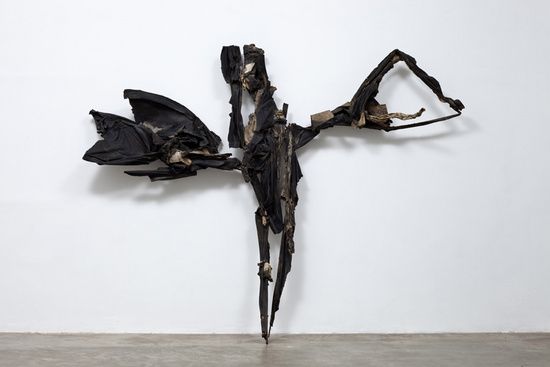
Robert Mallary's sculptures and assemblages, made from abject materials draped over wood and metal frames, line the walls of the Piccadilly gallery. 'Harpy' (1962), named after the violent, mythological creature with a human head and bird-like body, is a tattered, winged figure, constructed from old tuxedos over thin steel rods and frozen in place with polyester resin. With its looming body, outstretched arms and precarious pointed base, 'Harpy' evokes both the foreboding presence of a large, menacing figure and the vulnerability of a skeletal frame that could collapse to the ground at any moment.

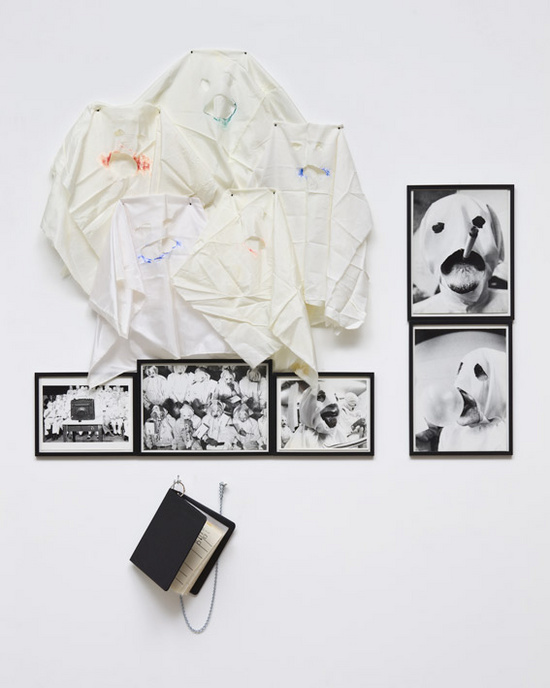
Barbara T. Smith was a pioneer of feminist performance art during the Sixties and Seventies. Archival material from a selection of her most well-known performances, such as 'Feed Me' (1973) and 'Scan 1' (1974), will be on display in 'The Historical Box'. These interactive performances used quasi-religious rituals, often led by the artist, to explore issues of gender, power and the spiritual in an overwhelmingly secular society.

Also addressing issues of power and gender, Judith Bernstein's works combine fervent and gestural mark-marking with her own unique brand of humour. Bernstein's 'Horizontal' (1973), a large-scale drawing of a twisting screw that was infamously censored from a 1974 exhibition at the Philadelphia Civic Center Museum, will be shown alongside the drawing 'Supercock' (1966), created during Bernstein's time as one of the few female graduate students at Yale School of Art. Both 'Horizontal' and 'Supercock' present a comical critique of the male-dominated art world, a world into which Bernstein and many other female artists were just beginning to break.

The exhibition is accompanied by a performance of Simone Forti's seminal Dance Construction, 'Hangers' (1961), first seen in Yoko Ono's Chambers Street loft in 1961. 'Hangers' straddles the boundaries of dance, performance art and minimalist installation. During the performance,
dancers balance in looped ropes hanging from the ceiling whilst additional performers walk between them, causing the ropes to sway subtly as they brush past. The ropes will remain throughout the duration of the exhibition as a sculptural remnant of the performance.

The exhibition will be accompanied by a screening of films by Stan VanDerBeek. VanDerBeek is considered by many to be one of the first multimedia artists.

Beginning as early as the Fifties and continuing throughout his career, VanDerBeek experimented ceaselessly with emerging forms of computer-based media and rudimentary animation. His works combined film with painting, photography, architecture, and mass-produced print media to create complex compositions in the spirit of Surrealist and Dadaist collages. A selection of animation frames from VanDerBeek's films are also on display in the exhibition.

For information on these and other events occurring in conjunction with 'The Historical Box', please visit the gallery's website: www.hauserwirth.com.

Scan 1 — Barbara T. Smith, 1974
3 vintage prints, 1 hood used during performance, 3 cue cards and lip print
Size variable

Harpy — Robert Mallary, 1962
Polyester, resin, impregnated tuxedos and steel
228.6 x 284.5 x 66 cm / 90 x 112 x 26 in
Photo: Fredrik Nilsen

HORIZONTAL — Judith Bernstein, 1973
Charcoal on paper
274.3 x 381 cm / 108 x 150 in
A La Mode — Stan VanDerBeek, 1959
Animation frame / Collage on paper
21.4 x 20.2 cm / 8 3/8 x 8 in


Tuesday, January 17, 2012

Issue No. 160: Spaces of Life


Spaces of Life: The Art of Sonya Rapoport presents a group of Rapoport's interactive works, created between 1979–2011 that function in the intersection between questioning and inviting.

Recognized for her early embrace of computer technology, in the mid 1970's, and participatory web-based works, Rapoport presents new works alongside earlier ones in an all encompassing installation that fuses the spaces of the museum with the energy of the artist's Berkeley home and studio. Rapoport's work has long operated as a bridge between the public sphere of intellectual curiosity and scholarship and the domestic one of spiritual inquiry and nurturing.

Central to the installation of Rapoport's work at the Mills College Art Museum is Objects on My Dresser (1979–1983), an 11-phase work intended as a kind of conceptual visit to the artist's home and studio. The titular dresser, which has occupied Rapoport's foyer for decades, is installed along with the original objects that sparked her investigation of the connections between symbols, words and ideas. Documentation of "netweb plots" created by Rapoport and by visitors to installations of previous project phases is included along with new plots created with Mills students and museum visitors. Rapoport's work continues to be influenced by a range of disciplines including technology, biochemistry, anthropology, psychology, and feminist studies. Visitors to Spaces of Life are encouraged to engage in ongoing, distributed performance actions that draw on these influences and related imagery.

Sonya Rapoport's sixty-year career spans painting, works on paper, interactive installations and digital works. Rapoport's approach to art-making is naturally diverse, underpinned by her pioneering use of scientific and social science research as the basis for a conceptual practice. Her work reveals deep philosophical and psychological perspectives, humor, expression, and creativity, which she brings to such topical concerns as gender, religion, politics, bioengineering, and the role of technology in contemporary life explored through interactive processes, systems and media.

This exhibition is supported by the Agnes Cowles Bourne Fund for Special Exhibition and the Hezel Family Foundation.


Related Public Programs
Opening Reception & Curator Walk-Through
Wednesday, January 18, 2012, 6–8pm

Objects on My Dresser: Artist Talk and Performance
Sunday, February 12, 2012, 1–3pm
With Sonya Rapoport, Dr. Revathi Vikram, psychiatrist, and gallery visitors.

Pre-Release Book Launch
Pairing of Polarities: The LIfe and Art of Sonya Rapoport, edited by Terri Cohn
Wednesday, March 7, 2012, 7pm
With Malcolm Margolin of Heyday Press.


About the Mills College Art Museum (MCAM)
Founded in 1925, The Mills College Art Museum is a forum for exploring art and ideas and a laboratory for contemporary art practices. Through innovative exhibitions, programs, and collections, the museum engages and inspires the intellectual and creative life of the Mills community as well as the diverse audiences of the Bay Area and beyond.


Contact:
Maysoun Wazwaz, 510-430-3340, mwazwaz@mills.edu